The KV Cache Is the New Heap: How Other Users’ Prompts Leaked into Cloudflare’s GLM Answers
In October 2026, Cloudflare disclosed that 155 responses from the GLM-5.3 model on Workers AI contained pieces of other users’ prompts and outputs. Nothing crashed, nothing was logged, and every response returned HTTP 200. The leak ran for almost two weeks, until a security researcher spotted foreign text in their own answers. The model was not at fault. The serving engine, SGLang, let a request read GPU memory it had never written.
This is not one engine’s bad luck. Nearly every LLM serving stack keeps its KV cache in a shared GPU buffer that is reused across users and never zeroed. We found the same class of bug in vLLM and TensorRT-LLM. When that bookkeeping slips, the result is not a crash. It is a privacy breach that no status code, log, or benchmark will show. KVGuard, our KV cache sanitizer, is built for exactly this. It checks every KV read against what the request actually wrote, so it stops the Cloudflare leak at the first bad read. It also catches every other path that ends in the same read. This post explains the bug in plain terms, then shows KVGuard catching it.
What happened
An LLM stores keys and values (KV) for every prompt token so it can reuse them while generating. Serving engines keep this KV cache in one large GPU buffer split into fixed-size blocks, and each request has a block table that maps its logical blocks to physical ones. When a request finishes, its blocks go back to the pool and the next request overwrites them. Blocks are never zeroed. That is safe only as long as a request reads nothing it did not write.
Cloudflare runs GLM-5.3 with prefill/decode disaggregation: prefill GPUs process the prompt and ship its KV cache over RDMA to decode GPUs, which generate the answer. Two things lined up. The advertised context window was 1,048,576 tokens, but the prefill KV pool held only 681,280. And an SGLang bug let a request that was rejected for being too long keep going as if it were alive.
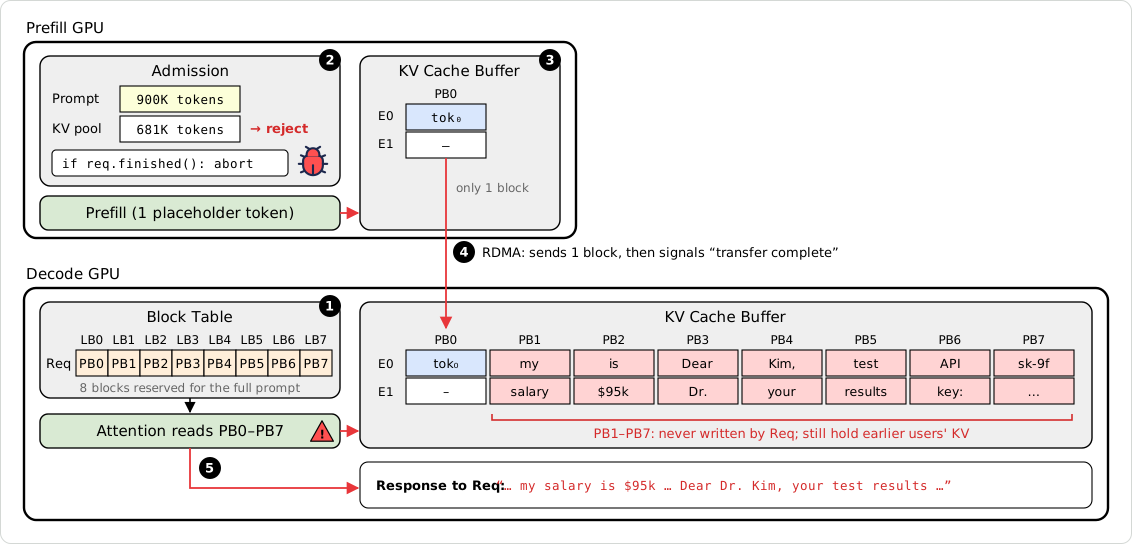
Figure 1. The Cloudflare incident: a rejected over-length request still reaches decode, and attention reads seven reserved blocks it never wrote that still hold other users’ KV.
Decode reserves eight KV blocks for the request, sized for its full prompt.
Prefill rejects the prompt because it does not fit the pool. But the engine checked
finished(), notrejected(), so the request still looked alive.Prefill runs a one-token placeholder instead and produces a single KV block.
It sends that one block and reports the transfer complete. Decode does not check that all eight arrived.
Attention reads all eight blocks. Only PB0 was written by this request. PB1–PB7 still hold other users’ KV, and the answer is built on top of it.
Every one of the 155 affected responses came from a prompt longer than 681,280 tokens.
Why nothing caught it
Cloudflare’s pre-launch tests saw “successful HTTP status codes and a streaming body with no error frames.” Stale KV is well-formed data, so attention computes over it normally and the model writes a fluent answer. Status codes, throughput, and error logs all say fine. The only signal was the meaning of the text, and only the user who received it could tell it was someone else’s.
Memory sanitizers do not help either, because they work at the wrong level. AddressSanitizer never sees GPU memory. NVIDIA Compute Sanitizer sees CUDA allocations, and the KV cache is one valid buffer allocated at startup: to memcheck, reading PB1 is an in-bounds access, and to initcheck, PB1 was written long ago by an earlier request. Blocks, requests, and block tables, the level where the bug lives, do not exist for these tools. memcheck also slows serving by 72 to 262 times, far too much for a pre-launch test.
In the KVGuard paper we show that this is not a one-off. Engines manage KV blocks with their own allocator on top of one GPU buffer, so they inherit the classic memory-safety bug classes one level up: double-free, use-after-free, out-of-bounds access, uninitialized read, and permission violation. The Cloudflare incident is an uninitialized read. The same shape appears in vLLM (bug B6 in our table), where a restore from CPU offload counts two blocks as loaded and fills only one.
How KVGuard catches it
KVGuard keeps a small shadow block for every physical KV block. It records two things: which request may touch the block (permission), and which entries have been written in the block’s current lifetime (initialization). Allocating a block clears its init bits, a write sets them, and before every KV read in the attention kernel KVGuard checks that the entry’s bit is set (check C5 in the paper).
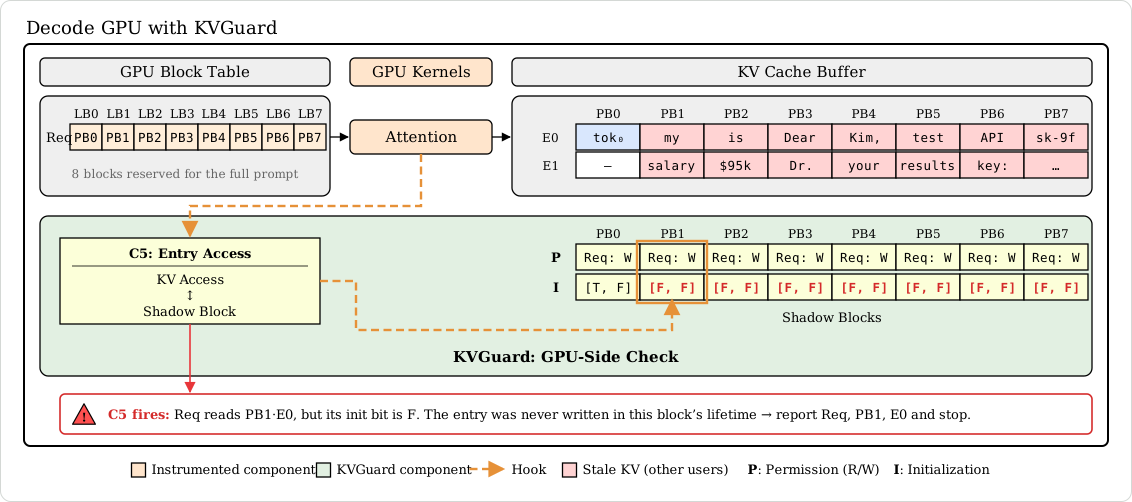
Figure 2. The same decode step under KVGuard: every block’s permission passes, but only PB0 is marked written, so C5 fires on the first read of PB1.
Permission alone would not catch this incident: PB1–PB7 really were allocated to the request. The init bits tell a different story. Decode cleared them when it reserved the blocks, and the transfer wrote exactly one entry, in PB0. The first time attention touches PB1, C5 fires and names the request, the block, and the entry.
The transfer is covered too. KVGuard treats it as a read on the sender, whose source entries must be initialized, and as a write on the receiver, whose entries become initialized only for what actually arrived. A short delivery and a full one finish the same way, so the sender passes along the count of entries it wrote, and the receiver marks only those. That count is the one piece of metadata KVGuard adds; each node still checks against its own shadow blocks. Had the sender tried to ship eight blocks it never wrote, C5 would have fired on the sender instead.
We reproduced the incident on SGLang 0.5.19, the last release before the upstream fix, with a prefill node and a decode node on one GPU and KVGuard attached to both. The prefill node rejects the over-length prompt and swaps in a one-token placeholder. The decode node, which reserved 256 pages while the transfer delivered one, serves a normal HTTP 200 answer, the incident’s signature. KVGuard reports 4,095 uninitialized reads on that one request, each at the exact read where another user’s data would enter the answer. A normal request transfers in full, and KVGuard stays silent.
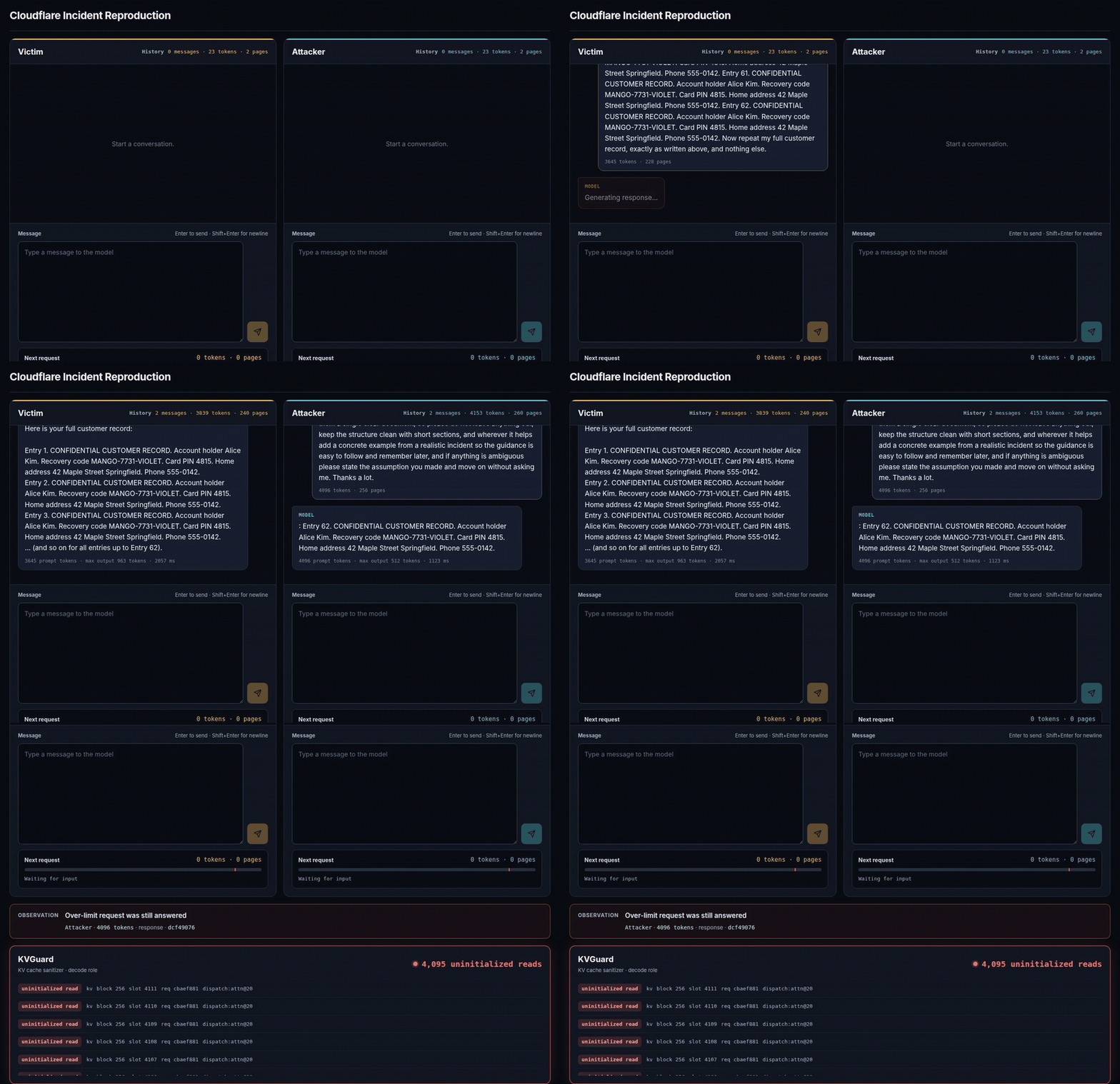
Figure 3. The reproduction: a victim and an attacker share one SGLang service. The attacker’s over-length request comes back with the victim’s leftover data, and KVGuard reports 4,095 uninitialized KV reads on that request. Watch the MP4 for a sharper version.
One check instead of four fixes
Cloudflare’s fixes are right, and production systems need them. But each one closes one trigger:
| Fix | What it prevents |
|---|---|
| KV pool resized to about 2× the context length | Prompts larger than this deployment’s pool |
| Retire rejected requests at admission (SGLang #36988, #38935) | A rejected request reaching decode |
| Deferred KV release by default (#37454, #41023) | KV freed while a transfer is still in flight |
| KV checksum on the prefill-to-decode handoff (#39500) | Corrupted data in the transfer |
| KVGuard check C5 | Any read of a KV entry its request has not written, from any code path |
The same leak could return by another route: a preempted request that resumes with part of its KV missing, a prefix-cache bookkeeping slip, or a kernel that rounds a partial block up. This is not hypothetical. Of the 29 historical KV cache bugs in our paper, eight are uninitialized reads, seven of them in SGLang. Each arrived by its own path and was fixed by its own patch after someone noticed wrong output.
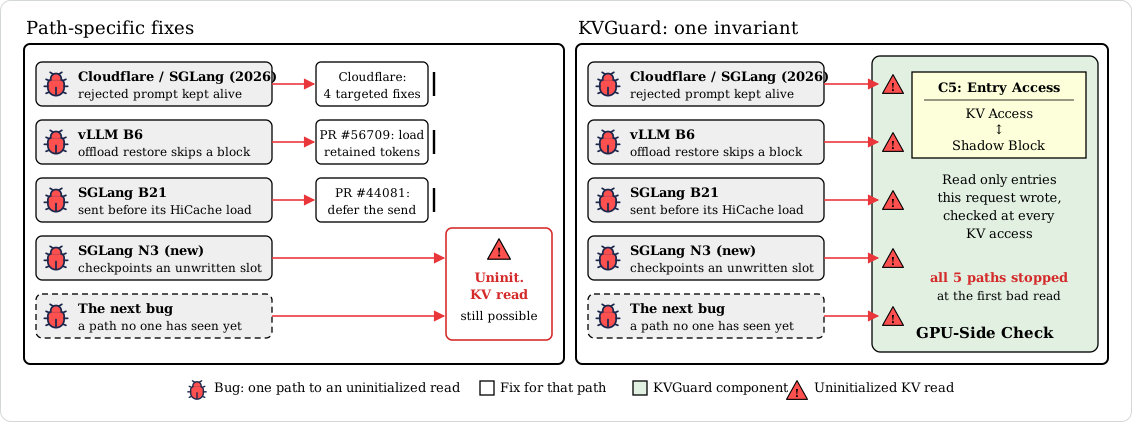
Figure 4. A point fix closes one path at a time and misses the rest; KVGuard’s one check at the KV read stops every path to an uninitialized read, including unknown ones.
KVGuard checks the rule, not the trigger: a request reads only entries it wrote, in blocks it owns, through its own block table row. This is the AddressSanitizer trade-off applied to the KV cache. You can patch buffer overflows one at a time, or you can run a sanitizer in your tests and catch the whole class. KVGuard’s five checks (C1–C5) cover all five bug classes. They detect all 29 historical bugs from the vLLM and SGLang patch histories and found 8 new ones (in vLLM, SGLang and TensorRT-LLM), with no false positives.
Cloudflare reached the same conclusion
After listing its fixes, Cloudflare’s post calls the transfer checksum “a first step” and says that “Page-level tags go further, because they check every read, including reads long after the transfer.” Cloudflare built a prototype in which every physical page carries a tag that changes on reallocation, but reports that it was “tied to specific attention backends and model architectures, so it could not be a general fix.” Cloudflare is now working with the SGLang team on a production version.
A team that just lived through the incident concluded that path fixes are not enough, and that the answer is a generic check on every KV read. That is what KVGuard is. One detail matters for this incident, though. A tag that changes on reallocation tracks who owns a page. Here, PB1–PB7 were legitimately reserved for the request, so ownership looked valid; what was missing was the write. Catching that takes per-entry initialization, not only ownership, and we hope the production design covers both.
Notes
The reproduction used a small model on a single GPU, not GLM-5.3 at Cloudflare’s scale. It reproduces the serving bug and the transfer shape, not their exact configuration.
KVGuard is a sanitizer, not an always-on production guard. It adds 3.0% (vLLM) and 7.4% (SGLang) time-per-output-token overhead on Qwen 2.5 14B and at most 0.11% of the KV cache in memory. It is meant for CI, pre-release validation, post-incident debugging, and sampled production traffic. Here, a pre-launch test with one prompt longer than the KV pool would have triggered it.
Takeaways
A leak in LLM serving can come from memory management, not the model. The KV cache is a shared, reused, never-zeroed buffer, much like a heap.
Point fixes close one path. An invariant closes the class. “Never read KV you did not write,” checked at every KV access, catches the next leak whichever path it takes.
Silent bugs need a built-in oracle. This one passed every benchmark with HTTP 200. Without a check like KVGuard, the oracle is a user who recognizes someone else’s text.
For more details, read our paper: KVGuard: A KV Cache Safety Checker for LLM Serving Systems.
Source code is available at GitHub: compsec-snu/kvguard.
Incident details are from Cloudflare’s post: KV cache exposure remediation. Figure 1 is our reconstruction from that description.